You can access sample input files for download here: DropBox
What is SD GCM software?
SD-GCM V2.1 (Statistical Downscaling of General Circulation Models) is a Windows desktop application for statistical downscaling and bias correction of CMIP6 GCM output to the scale of local weather stations. It supports CMIP6 models under all SSP scenarios and is also compatible with CMIP5 RCP scenarios and CORDEX regional climate models. Users can also apply the tool for bias correction of any gridded dataset in NetCDF format.
SD-GCM V2.1 provides six bias-correction and statistical downscaling methods:
- Delta — corrects the mean bias by a seasonal scaling factor (Panofsky & Brier, 1968)
- QM (Quantile Mapping) — maps GCM quantiles to observed quantiles using a Normal CDF for temperature and empirical CDF for precipitation (Wood et al., 2002)
- EQM (Empirical Quantile Mapping) — fully non-parametric quantile mapping using sorted data directly (Boé et al., 2007)
- QDM (Quantile Delta Mapping) — preserves the GCM-projected change signal at every quantile (Cannon et al., 2015) New in V2.1
- DQM (Detrended Quantile Mapping) — removes the mean trend, applies EQM, then reapplies the trend (Cannon et al., 2015) New in V2.1
- SDM (Scaled Distribution Mapping) — corrects wet-day frequency and intensity simultaneously using rank-based mapping (Switanek et al., 2017) New in V2.1
These methods enable users to perform accurate downscaling of climate data, facilitating in-depth analysis and exploration of various climate scenarios. The SD GCM tool stands as a valuable resource for climate researchers and users seeking precise statistical downscaling capabilities.
To perform downscaling, three essential datasets are required: observation (station) data, historical data, and RCPs/SSPs data. However, if your focus is on evaluating GCM (General Circulation Models), you will only need observation and historical data.
Within this comprehensive package, users have the flexibility to work with a wide range of datasets. You can effortlessly read and utilize any CMIP5/CMIP6 model under various RCP/SSP scenarios or any Gridded Dataset in NetCDF file format. Additionally, the tool allows you to input your own gridded data in Excel format, providing even greater versatility in your research and analysis.
The SD GCM software offers a unique option for evaluating model data, which is available in the unregistered version as well. During this evaluation phase, users can assess the performance of CMIP5/CMIP6 models by comparing them with observation data over a shared time period.
For conducting the evaluation, the observation data should be provided in an Excel format file, while the historical data of the models must be in NetCDF format. The evaluation process employs six efficiency criteria to gauge the model's accuracy:
- MAE (Mean Absolute Error)
- MBE (Mean Bias Error)
- Pearson Correlation (r)
- Spearman Rank Correlation (ρ) New
- NSE (Nash-Sutcliffe Efficiency)
- RMSE (Root Mean Square Error)
- NRMSE (Normalised RMSE) New
- IoA — Index of Agreement (d)
- KGE (Kling-Gupta Efficiency) New
- PBIAS (Percent Bias) New
- RSR (RMSE / StdDev ratio) New
- WDF (Wet-Day Frequency Ratio) New
By utilizing these criteria, researchers can effectively analyze and quantify the methods model's performance against observed data, gaining valuable insights into the model's capabilities and limitations. The evaluation phase empowers users to make informed decisions and interpretations, fostering robust research in climate and weather analysis.
SD-GCM V2.1 supports daily, monthly, and 3-hourly CMIP6 data as well as CORDEX and other gridded NetCDF datasets. The new version integrates a direct Copernicus CDS downloader so you can stream CMIP6 data for your station locations without manually downloading multi-gigabyte files. All methods now support Monthly Stratification (separate transfer functions per calendar month), and LOCI (Local Intensity Scaling) pre-processing is automatically applied to all precipitation methods to correct the GCM drizzle bias before quantile mapping.
Here are some of the key abilities and features offered by the tool:
- Six Bias-Correction Methods: Delta, QM, EQM, QDM, DQM, and SDM — covering a range of approaches from simple mean scaling to quantile-delta preservation for future extremes.
- Monthly Stratification: Any of the six methods can be run separately for each calendar month, correcting seasonal bias patterns that a global transfer function would miss. Output is labelled with the
_M suffix.
- LOCI Pre-processor: Local Intensity Scaling is automatically applied before all precipitation quantile-mapping methods to correct the GCM wet-day frequency and mean intensity before the CDF transfer function is applied.
- Copernicus CDS Download: Download CMIP6 data for your station locations directly from the Copernicus Climate Data Store without manually handling large NetCDF files. Supports 25+ variables and all major CMIP6 models and SSP scenarios.
- Multi-Station Batch Processing: Run downscaling for hundreds of stations in a single job. Processing speed depends on available CPU and RAM.
- Flexible Input Formats: Load historical and SSP/RCP data from NetCDF files, Excel/CSV, or the integrated CDS downloader.
- 12 Evaluation Metrics: MAE, MBE, RMSE, NRMSE, Pearson r, Spearman ρ, NSE, IoA, KGE, PBIAS, RSR, and Wet-Day Frequency Ratio (WDF). Compare all methods side by side in the Method Comparison table.
- Distribution Analysis: Fit up to 15 probability distributions to your output data, ranked by the Anderson-Darling statistic. Plot CDFs and PDFs with empirical overlays.
- Data Counter: Count threshold events (wet days, heat days, drought days) per year or month for any data source — observed, raw GCM, or bias-corrected.
- Free Evaluation Mode: The unregistered version allows full evaluation of all six methods but does not save downscaled output. Purchase a license to unlock saving.
Video Tutorials
How to Download CMIP6 MIROC6 Data from Copernicus CDS | SD-GCM
Watch how to download CMIP6 climate data (MIROC6 model, historical and SSP scenarios) directly from the Copernicus Climate Data Store for your station locations using the built-in CDS downloader in SD-GCM V2.1 — no manual handling of multi-gigabyte NetCDF files required.
Statistical downscaling methods employed within the SD GCM Tool
SD-GCM V2.1 offers six bias-correction and statistical downscaling methods. The three original methods (Delta, QM, EQM) have been enhanced with LOCI precipitation pre-processing and Monthly Stratification. Three new methods (QDM, DQM, SDM) have been added in V2.1:
Subsection
Delta statistical downscaling method (Dessu and Melesse, 2013):
Delta Method: The Delta method is one of the downscaling techniques available in the SD GCM tool. It involves calculating the difference (delta) between the GCM model data and observed data over a specific historical period. This delta is then applied to the GCM projections to adjust and refine the climate data, providing more accurate and localized information.
As presented in Eq. 1 and Eq. 2 the precipitation and temperature of GCM data are downscaled
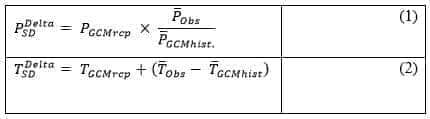
where, P(SD,Delta) and T(SD,Delta) are downscaled data of precipitation and temperature, respectively. P(Obs) refers the average observed and P(GCMhist) represents to GCM mean simulation historical data of precipitation. Subscript GCMrcp represents the GCM's RCP outputs over the future period and subscript Obs represents the observation values. In Eq. 2 all the subscripts are the same as Eq. 1 for temperature.
SD-GCM V2.1 Tutorial | Statistical Downscaling & Bias Correction of CMIP6 Climate Data
This complete SD-GCM V2.1 tutorial walks through the full workflow: loading station and CMIP6 NetCDF data, evaluating GCM performance, and applying all six bias-correction methods (Delta, QM, EQM, QDM, DQM, SDM) with LOCI pre-processing and Monthly Stratification.
Quantile Mapping (QM) statistical downscaling method
QM (Quantile Mapping) Method: The Quantile Mapping method, another option in the SD GCM tool, works by mapping the cumulative distribution functions (CDFs) of the GCM model data and observed data. By matching the quantiles of the two datasets, the method adjusts the GCM projections to better align with the observed data's statistical characteristics. This process leads to improved downscaled climate information.
As Panofsky and Brier (1968) revealed, QM is a statistical downscaling method that has been used in different field of studies. In the equation of QM, the modelled probabilistic distribution to observed probabilistic distribution is calculated. This concept is computed as Eq. 3 for precipitation data. SD GCM uses Eq 3-1 for evaluation and Eq 3-2 for future downscaling.
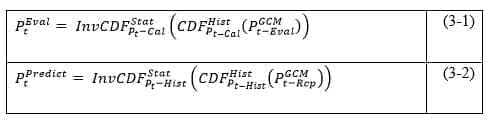
In the presented equation (Eq. 3), CDF is the cumulative distribution function of the observation and GCM data, over considering period.
Empirical Quantile Mapping (EQM) statistical downscaling method
EQM (Empirical Quantile Mapping) Method: The Empirical Quantile Mapping method is a variant of the traditional QM method and is also available in the SD GCM tool. Similar to QM, it involves matching the CDFs of GCM and observed data. However, EQM introduces additional corrections to the data, making it more robust and accurate, particularly in extreme weather events.
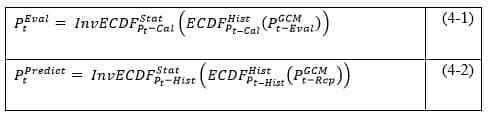
Wetterhall and his colleagues (2012), have published a complete paper for statistical downscaling methods, as EQM. The EQM employs the empirical cumulative distribution function (ECDF) as Eq. 4, and all the items are the same as Eq.1. SD GCM uses Eq 4-1 for evaluation and Eq 4-2 for future downscaling.
Quantile Delta Mapping (QDM) — New in V2.1
QDM: Introduced by Cannon, Sobie & Murdock (2015), QDM extends EQM by preserving the GCM-projected change signal at every quantile of the distribution. For each future GCM value, QDM computes its quantile in the future GCM distribution, finds the historical GCM value at the same quantile, and adds the difference (the quantile delta) to the observed station value at that quantile. This ensures that projected changes in extreme events — not just the mean — are retained in the downscaled output. For precipitation, the delta is multiplicative and LOCI pre-processing is applied first.
Detrended Quantile Mapping (DQM) — New in V2.1
DQM: Also from Cannon et al. (2015), DQM is a simpler alternative to QDM that preserves only the mean change signal. It temporarily removes the mean trend from the future GCM data, applies EQM to the detrended values (which now look statistically similar to the historical period), then reapplies the trend to the corrected output. DQM is a good choice when the primary concern is correcting distributional bias while retaining the projected mean warming or mean precipitation change.
Scaled Distribution Mapping (SDM) — New in V2.1
SDM: Developed by Switanek et al. (2017), SDM is specifically designed for precipitation. Rather than mapping through cumulative probability, SDM maps through exceedance probability (1 − p). For precipitation, it explicitly corrects the GCM drizzle bias: wet days in the future GCM are sorted by intensity, the lightest-intensity excess wet days (those above the observed wet-day count) are set to zero, and the remaining wet days are mapped rank-by-rank to the observed distribution. This makes SDM the most physically consistent method for precipitation extremes analysis.
What is the downscaling concept?
The raw outputs obtained from General Circulation Model (GCM) simulations may not be sufficient for accurately assessing the impact of hydrological, agricultural, and other studies. This limitation arises due to the inadequate and overly coarse spatial scale of GCMs outputs, typically around 250 km. To overcome this challenge, scientists employ various methods, with downscaling being a key solution. Downscaling serves as a bridge between coarse and fine-scale climatic data, enabling more precise analysis and projections.
Downscaling can be carried out on both spatial and temporal aspects of climate projections. Spatial downscaling specifically focuses on extracting finer-resolution spatial climate information from the coarser-resolution GCM output. For example, it allows the conversion of GCM output with 500 kilometers grid cells into a 20 kilometers resolution or even to a specific location.
By using spatial downscaling techniques, researchers can obtain more localized and detailed climate data, which is vital for enhancing the accuracy and relevance of various studies related to climate impact assessments, resource management, and planning in diverse fields.
There are broadly two types of downscaling: Dynamical Downscaling (DD) and Statistical Downscaling (SD) (Christensen et al., 2007). DD, nesting a fine scale climate model in a coarse-scale model, produces spatially complete fields of climate variables. DD is very computationally intensive, making its use in impact studies limited, and essentially impossible for multi-decade simulations. DD models are very complex and require substantial computational resources, often at the same level as required for GCM simulations. The implementation of these models is prone to error. DD involves a regional climate model (RCM) used to model the target region at finer scales bounded by larger GCM nodes.
SD (Statistical Downscaling) methods dondon't require significant computational resources and they can easily run by a simple computer with relying on simple regression analyses in a flash time, so, due to the ease of their implementation, these methods have a high opportunity that will select from related users. A vast number of techniques have been developed for SD and these are based on the determination of statistical relations between large-scale synoptic predictors and local observations from ground stations. SD can produce site-specific climate projections, which DD cannot provide since they are computationally limited to a 20–50 kilometers spatial resolution. One advantage of SD techniques is that they are less computationally intensive and hence can be used to downscale many GCM (or RCM) climate projections. Furthermore, compared to DD methods, the SD method is relatively easy to use and provides station-scale climate information from GCM-scale output.
In general, the statistical methods can be divided into three categories: regression (transfer function) method (e.g. Kang et al. 2007), stochastic weather generator (Richardson 1981) and weather pattern schemes. There is a numerous number of statistical downscaling methods. One of the most popular and common of them is Bias Correction (BC) that has been applied extensively for impact assessment and employed in climate change studies in all over the world (Wood et al., 2002; Payne et al. 2004). One of the best references for review of different kind of BC approaches can be found in Themeßl et al. (2012).
The license of this tool is applicable for one year of using and you can renew it by pay 20% of the price for the new year.